Peter Orullian contest winners!


Our three winners will get their hands on Peter Orullian's fantasy debut, The Unremembered, courtesy of the nice folks at Tor Books. For more info about this title: Canada, USA, Europe.


You can also take a look at the fifth webisode set in the universe of The Vault of Heaven.

The winners are:

- Patrick Kelly, from St. Catharines, Ontario, Canada

- Assaf Vestin, from Huntington, New York, USA

- Stephanie M. Lorée, from Toledo, Ohio, USA

Many thanks to all the participants!

Game of Thrones "Epic" trailer


T-minus 3 days. . .

Sunday night can't come soon enough!

R. Scott Bakker contest winners!


The book is out in Canada and the USA!!! =)

Thanks to the generosity of the folks at The Overlook Press, our winners will receive a complimentary copy of R. Scott Bakker's The White-Luck Warrior. For more info about this title: Canada, USA, Europe.

The winners are:

- Joshua Pryor, from Cadiz, Kentucky, USA

- Eric Toczek, from Tonawanda, New York, USA

- Ryan Sposato, from Rochester, New York, USA

- Wil Barnes, from La Grange, North Carolina, USA

- Nate Burnard, from Huntington, Indiana, USA (Bonehunter on malazanempire.com)

Many thanks to all the participants!

Argentina and Chile photo album


Totally forgot to post these pics! So here are the remaining pictures from Argentina and Chile.

Just follow this link to have a look. . .

The Dragon's Path


Mea culpa: Although I own every volume part of Daniel Abraham's The Long Price Quartet, I have yet to read the first installment. Hence, this would be my first foray into the author's long form works. I absolutely loved Leviathan Wept and Other Stories last summer, and I was thus looking forward to reading the opening chapter in The Dagger and the Coin sequence.

Though certain facets of The Dragon's Path show a lot of promise and potential, I had mixed feelings about the novel as a whole when I reached the last page.

Here's the blurb:

Summer is the season of war in the Free Cities.

Marcus wants to get out before the fighting starts. His hero days are behind him and simple caravan duty is better than getting pressed into service by the local gentry. Even a small war can get you killed. But a captain needs men to lead — and his have been summarily arrested and recruited for their swords.

Cithrin has a job to do — move the wealth of a nation across a war zone. An orphan raised by the bank, she is their last hope of keeping the bank’s wealth out of the hands of the invaders. But she’s just a girl and knows little of caravans, war, and danger. She knows money and she knows secrets, but will that be enough to save her in the coming months?

Geder, the only son of a noble house is more interested in philosophy than swordplay. He is a poor excuse for a soldier and little more than a pawn in these games of war. But not even he knows what he will become of the fires of battle. Hero or villain? Small men have achieved greater things and Geder is no small man.

Falling pebbles can start a landslide. What should have been a small summer spat between gentlemen is spiraling out of control. Dark forces are at work, fanning the flames that will sweep the entire region onto The Dragon’s Path — the path of war
.

The worldbuilding is at times brilliant, but this aspect also leaves much to be desired in other instances. The entire back story regarding dragons and their fallen empire was utterly fascinating, and I wish we could have learned more about it. The many vestiges of the dragons' civilization definitely added depth to this tale, hinting at countless secrets from the past left to be discovered. Another concept which could have been interesting but turned out to be a failure to launch was the various races. For reasons that remain unexplained, humanity is now split into thriteen different races, all of them born from the Firstblood mold. Problem is, other than disparate physical traits, it appears that humanity, as a whole or sundered in its myriad forms, has no history, mythology, and religion; nothing to give each of the races its identity as a society. So much had been made concerning the thirteen races prior to the book's release that I was persuaded that this would set The Dragon's Path apart from the competition. I was expecting a panoply of diverse cultures, all with their own traditions and beliefs. Sadly, the total absence of depth in that regard -- thus far -- was a definite letdown.

The politicking isn't polished enough, I felt, and in the end everything seemed a bit too contrived for my taste. In terms of court intrigue, not every author can be as talented as George R. R. Martin or Katherine Kurtz. And yet, if a good chunk of your premise depends on this, then the politicking needs to be up to snuff.

The characterization did nothing for me, unfortunately. Which is odd, given the fact that it's not because the story isn't populated by well-defined protagonists. Most characters are nicely realized men and women, each with his or her own back story. But for some reason -- and God knows I've tried to put my finger on it in the last two weeks -- the characters all left me indifferent. Which doesn't really bode well for me. One must give Daniel Abraham credit for playing with our own preconceptions of fantasy stereotypes. The author managed to mix things up by using popular genre tropes, only to turn the table on the readers later on. Still, Marcus was never able to rise above the clichéd warrior who has seen enough of violence. The same can be said of Dawson, the typical nobleman. Though she did nothing for me as a character, Cithrin's storylines is likely the most interesting of the bunch. Abraham tackling commerce and everything it encompasses as an arc shows a lot of promise. The most intriguing character remains the Apostate, and I'm curious to see how his plotline will influence the rest of the series.

The pace is a bit uneven here and there, yet the novel's narrative flows well for the most part. The prose doesn't grab hold of you the way I anticipated, but it does create a vivid imagery.

The structure of the book follows that of George R. R. Martin's A Song of Ice and Fire. Instead of regular chapter, the book is divided in POV sections. The Dragon's Path features the points of view of Marcus, Geder, Cithrin, Dawson and his wife Clara, as well as that of the Apostate.

All in all, though it might not be the sort of opening chapter I was expecting, The Dragon's Path shows a lot of potential. Whether or not Daniel Abraham can up his game in the second installment remains to be seen. Yet, as many have pointed out, The Long Price Quartet got better and better with each new volume, so here's to hoping that it will be the case here as well.

Though The Dragon's Path is a solid effort, in several aspects the execution fell a little flat.

The final verdict: 7.25/10

For more info about this title: Canada, USA, Europe

Wicked Pretty Things and the Erasure of LGBTQ Characters


Thanks to Patrick Rothfuss for spreading the word about this! =)

This from Jim C. Hines website:

Last night, my six-year-old and I had a chat. I don’t remember how it came up, but he was talking about people getting married, and how boys have to marry girls. I pointed out that this wasn’t necessarily so, that in some states and many countries, boys could marry boys and girls could marry girls.

Being six, he laughed. “That’s silly. How would they have babies?”

It’s not the first time we’ve had a talk like this. I understand where his confusion comes from. Pretty much every cartoon on TV has male/female relationships only. Every movie he watches, every book he brings home from school… Any nonheterosexual relationship is simply erased.

Last month, Jessica Verday withdrew her story from the Wicked Pretty Things anthology after receiving a note from the editor which stated that her story “would have to be published as a male/female story because a male/male story would not be acceptable to the publishers.”

Wicked Pretty Things is an anthology of dark fairy romance … but apparently editor Trisha Telep assumed that meant straight romance only, going with the default erasure of any “nontraditional” relationships.

Verday later posted a response in which Telep apologized for causing offense, and said in part, “I sincerely regret the sequence of events which has led to Jessica Verday’s story ‘Flesh Which Is Not Flesh’ being excluded from the forthcoming anthology Wicked Pretty Things. This has been the result of a misunderstanding on my part which is entirely regrettable … I fully support LGBTQ issues.”

I understand and believe that Telep meant no harm. That it was a mistake, not intended to be hurtful. But it was hurtful.

Other authors such as Seanan McGuire, Lisa Mantchev, Lesley Livingston, and Karen Mahoney have pulled their stories from the anthology. Melissa Marr asked that her name not be used to promote the project (she had provided a cover blurb Correction: they were apparently describing the anthology as including stories with a “Melissa Marr-ish slant.”) Ann Aguirre pulled her story from another of Telep’s projects.

Running Press responded in an article titled The Misinformation Age, saying, “Third-party error and miscommunication went viral and led to the spread of untrue accusations of intolerance and censorship.”

Where exactly are these untrue accusations? I’m not aware of any lies in Verday’s post, or in the posts by the other authors involved. Is intolerance an inappropriate word to describe an editor who says “No gay love allowed,” even if it was a misunderstanding?

More importantly, why was this an issue to begin with? The publisher may have disavowed responsibility for Telep’s actions, but why did Telep immediately assume that a story in which two male characters were in love would be unacceptable?

Pulling a story from an anthology is scary. You risk alienating editor and publisher both, not to mention turning down a paycheck. You worry about appearing unprofessional. And you wonder if you’ll find another home for the story you worked so hard on…

I’ve been thinking about this a lot, and I’d like to extend an offer to any author who pulled his or her story from one of Telep’s projects as a result of this incident.

1- If you have not already found a home for your withdrawn story, I would be happy to read it.
2- If I like the story (and knowing most of the authors involved, I suspect I will), I’ll offer $100 up front to publish it here on my blog.
3- Each story will include a donations link. Once the initial $100 has been covered, further donations will be split 50/50. Half will be paid to the author, and the other half will be donated to a LGBTQ-friendly cause.
4- If I publish multiple stories, I will look into putting together an e-book collection of those stories, with profits again being split between the authors and a LGBTQ-friendly cause.

I get about 2000 unique readers each day, which is comparable to (or in some cases better than) the sales for a number of the anthologies out there. That said, I’ll certainly understand if the authors choose to look elsewhere. It sounds like Verday has already found another home for her story, which is great. My offer is not time-limited.

I am not trying to poach authors from Running Press. However, I do want to support and thank those authors who’ve chosen to publicly state that the erasure of non-straight characters and relationships is not okay. One way I can do that is by offering a home for those stories.
----------------

Great initiative!

New Game of Thrones "Poison" trailer


Only 6 more days before the premiere!

SUBTERRANEAN: TALES OF DARK FANTASY 2 contest winners!


Thanks to the kind folks at Subterranean Press, our winners will get their hands on a copy of the trade hardcover edition of Subterranean: Tales of Dark Fantasy 2. For more info about this title: Canada, USA, Europe, and Subpress.

The winners are:

- Michael Lenzo, from Columbus, Ohio, USA

- Carole Fleres, from Leudelange, Luxembourg

- Jarred Payne, from Cocoa, Florida, USA

- Bob Crampton, from Virginia Beach, Virginia, USA

- Sabrina Osborn, from Shoreline, Washington, USA

Many thanks to all the participants!

A bit of humor. . .


PMS. . . :P

This week's New York Times Bestsellers (April 5th)


In hardcover:

Paul S. Kemp's Star Wars: The Old Republic: Deceived debuts at number 13.

Deborah Harkness' A Discovery of Witches is down seven spots, finishing the week at number 15. For more info about this title: Canada, USA, Europe.

Patrick Rothfuss' The Wise Man's Fear is down eleven positions, ending the week at number 16. For more info about this title: Canada, USA, Europe.

Patricia Briggs' River Marked is down fifteen spots, finishing the week at number 28.

Elizabeth Moon's Kings of the North debuts at number 29.

Kim Harrison's Pale Demon is down thirteen positions, ending the week at number 32.

In paperback:

George R. R. Martin's A Game of Thrones returns at number 10.

Jim Butcher's Changes is down seven spots, finishing the week at number 21.

Max Brooks' World War Z: An Oral History of the Zombie War is down two positions, ending the week at number 24 (trade paperback).

Patrick Rothfuss' The Name of the Wind is down four spots, finishing the week at number 28.

George R. R. Martin's A Game of Thrones debuts at number 34 (trade paperback).

The Making of HBO's Game of Thrones


The making of Game of Thrones from HBO!

Win a copy of Robert McCammon's THE FIVE


Thanks to the generosity of the folks at Subterranean Press, I have five signed copies of the trade hardcover edition of Robert McCammon's The Five up for grabs! For more info about this title: Canada, USA, Europe, and Subpress.

Here's the blurb:

Robert McCammon, author of the popular Matthew Corbett historical thrillers (Speaks the Nightbird, Mister Slaughter), now gives us something new and completely unexpected: The Five, a contemporary novel as vivid, timely, and compelling as anything he has written to date.

The Five tells the story of an eponymous rock band struggling to survive on the margins of the music business. As they move through the American Southwest on what might be their final tour together, the band members come to the attention of a damaged Iraq war veteran, and their lives are changed forever.

The narrative that follows is a riveting account of violence, terror, and pursuit set against a credible, immensely detailed rock and roll backdrop. It is also a moving meditation on loyalty and friendship, on the nature and importance of families—those we are born into and those we create for ourselves—and on the redemptive power of the creative spirit. Written with wit, elegance, and passionate conviction, The Five lays claim to new imaginative territory, and reaffirms McCammon’s position as one of the finest, most unpredictable storytellers of our time
.

Says Stephen King:

The Five isn't just Robert McCammon’s best novel in years; it’s his best novel ever. Terrifying, suspenseful, unputdownable, and full of rock and roll energy. It’s also uplifting, a book you’ll finish feeling better about your world, your friends, and your music. Here’s one you’ll beg friends to read.

The rules are the same as usual. You need to send an email at reviews@(no-spam)gryphonwood.net with the header "FIVE." Remember to remove the "no spam" thingy.

Second, your email must contain your full mailing address (that's snail mail!), otherwise your message will be deleted.

Lastly, multiple entries will disqualify whoever sends them. And please include your screen name and the message boards that you frequent using it, if you do hang out on a particular MB.

Good luck to all the participants!

Steven Erikson interview


Okay, so I was asked to do a Q&A with Steven Erikson, author of the bestselling The Crippled God (Canada, USA, Europe), prior to the book's release, but my flying away to South America precluded my doing just that.

Understandably, upon my return I knew I wanted to interview Erikson again. Two of my usual partners in crime joined me for this new Q&A: Adam (www.thewertzone.blogspot.com) and Ken (www.nethspace.blogspot.com). In addition, a number of questions were submitted by the animals from the nuthouse aka www.malazanempire.com.

All in all, once again I think that we came up with a good bunch of questions, making for a balanced Q&A. Many thanks again to Steven Erikson for taking the time to do this!

Enjoy
----------------------------

- How pleased are you with fans' reactions to The Crippled God thus far?

I am receiving many more emails from fans via the StevenErikson.com site and of those, only one arrived where a reader spent a page or so telling me how much he disliked The Crippled God. What always surprises me is how someone – anyone – would imagine that I would a) read through such an email; and b) respond to it. Imagine making a list of everything you don’t like and then writing to the subject of such dislikes – I can’t think of a bigger waste of time (surely, this person had better things to do with their time!). Or try it from the other side: imagine receiving hate mail from people you don’t even know, relating all the ways you disappointed them. What would you do with this? I suppose if I was a masochist I might delight in reading such attacks, but really, I’m not. I am pleased when people write to say they enjoyed the novels, even if they have specific criticisms, and of course every reader absorbs a story in a different way, which is a good thing. And that kind of exchange is a gift for which I feel very privileged.

On the fan-site one long-time participant flamed off on The Crippled God and has since quit the site. I admit to being somewhat taken aback by her vehemence: certainly Dust of Dreams signposted the direction I would be taking with The Crippled God. I can’t imagine what she was expecting, but it would be nice to think she might one day revisit the series (though, given that she felt she’d wasted years of time reading the series, that’s not very likely). To me, the narrative of this series has felt continuous and consistent, but it just goes to show that one can never be certain of someone else’s expectations.

In general, however, I am pleased with the response; and was delighted to read (on Nethspace) the first effort at reviewing the entire series – which cannot help but be a daunting prospect for anyone.
 
- It took a number of years for The Malazan Book of the Fallen to achieve both critical and commercial success. While the series will probably never be "mainstream" SFF material the way works by Terry Brooks, Raymond E. Feist, R. A. Salvatore, and Patrick Rothfuss are, how rewarding is it to see The Crippled God hit bestseller lists on both sides of the Atlantic?

It’s pleasing to see any fantasy genre novels among the bestseller lists: it would be even nicer if a few mainstream reviewers actually took notice.
 
- In The Crippled God we saw many small cameo appearances, some crucial, from earlier characters in the series, something that didn't seem to happen much in the first few books. Did you enjoy the fact that in the second half of Dust of Dreams and the conclusion to the series overall you could be slightly less forgiving to newcomers and perhaps indulge the fans a little more by addressing other storylines and characters?

Consider it this way: I humbly asked readers to invest in and engage with a story thousands of pages long and over a decade in the telling. Do you think I would simply pretend that they aren’t there, brimming with their own hopes and desires? Someone noted on the fan site that they felt as if I was writing directly to some of them and the truth is, I was. How could I not seek to return the loyalty I’ve been given? At the same time I couldn’t do that gratuitously: everything needed to either fit with the events or echo scenes from earlier novels. But both of those serve to tip the hat to the readers, as they (hopefully) recognize those echoes.

In my mind, it is always a dialogue, and maybe in that sense the relationship between author and audience has evolved in the last twenty or so years. There is a give and take going on that never existed before, not to this extent, anyway, and for me it would be foolish to ignore it, or denigrate it. If I throw on my anthropologist glasses, I might even suggest that we are returning to the origins of storytelling as a participatory event, and even as we all engage in that we also, perhaps mostly unawares, become a story unto ourselves. People rarely think of participating in history, for example, unless it’s at easily recognizable, pivotal moments: but the less recognizable ones are the real driving forces of history, and we’re all in it, all the time. In some respects, this is what TMBOTF was all about, not just in the story being told, but in the dialogue it presented (if that sounds highblown, it’s not meant to: I am speaking here of my own sense of things, in that I invested twelve or so years, day in day out, with this tale, and felt in a sustained conversation with thousands of people; and when it was all done, I more or less stumbled off stage, both punch-drunk [took a lot of punches along the way] and run-through. But for all that, it still seems a modest contribution on my part).

- The end of The Crippled God leaves some key characters hanging out in the shattered remains of the Kolanse empire. We know from the epilogue that some eventually get back to the Malazan Empire, but there still seems to be some loose ends there. Is that somethig you're leaving for readers to ponder or will your or Ian's future books expand on what happened to the surviving Bonehunters and members of the Host following the end of the series?

A bit of both. Cam needs room for his stories, and they need to remain relevant. And it may be that I will revisit some of the characters with the Karsa trilogy (or not). But also consider the whole notion of history, as I mentioned above – just as each and every reader now goes on, gets on with their lives, so too do these fictional characters. We all gathered for the tale (man, I wrote that scene in countless ways throughout the series, didn’t I?) and now we all go our own ways, and life goes on. Curiously, when I was in the midst of finishing TCG, my mind started wandering back to my high school days. I went so far as to try and track a few old friends down. This is not coincidental. We all have that desire to know what’s come of people we once knew. I was probably subconsciously reacting to what I was writing, to the sense of saying goodbye and leaving behind all those ‘old friends.’ The notion that a writer can just leave the work at the end of the day is nonsense: writing is all about being haunted, without respite, until the tale is told. This series has haunted me for about twenty years, all told. I’m still numb with the sudden silence.
 
- Will fans have a chance to see you and Esslemont at a number of conventions or events in the coming months?

Got a gig in Milan this June, and then there’s San Diego and of course the British Fantasy Con in Brighton this autumn. The following year I’ll be in Paris for a really cool symposium, talking about Classical influences on my series. I honestly can’t wait for that one. As for Cam, well, being up in Fairbanks makes travel a bit dear, but I do hope to see him in San Diego, at the very least.

- You and Cam have repeatedly said that the Malazan world and the story that you are telling originated in a role-playing campaign and that you role-played a large number of the characters that eventually star in the series. Since the two characters that really connect everything together in the series are Shadowthrone and Cotillion it seems a good guess that you guys spend a lot of time gaming through them. So, are you Shadowthrone or Cotillion?

I was Cotillion; Cam was Shadowthrone. We still are and have been throughout the novels. The Nethspace review of the series finally mentioned the notion that this series is postmodern fantasy. You have no idea how long I’ve been waiting for someone to say that,

- You're currently writing the first book in the new trilogy and in another interview you mentioned that you consider it more "traditional" compared to the main series you completed. Are you structuring this new book as a possible starting point for new readers or do you believe that new readers will continue to follow the publication order? Do you feel the necessity of varying your tones or reach out for new readers, doing different things? In which way that "traditional" distinguishes the new book from your other ones, or even your approach to it?

I mulled over this issue for some time (I still am, in fact). This new trilogy needs to serve two audiences in my mind. The first audience is the one I already have, and they should have fun with this, as many questions are answered as to origins, etc. The second audience is one that is perhaps daunted by the idea of plunging into the MBOTF, and so for them I’m taking a more traditional route, in terms of exposition and structure. The writing feels more measured, I suppose, but then it has to as I am approaching this trilogy with a different scale in mind (not Homeric). Achieving a balance between the two is the challenge here. Thus far, it has been a pleasure to write.

- You've said that the next books, the prequel and sequel trilogies, will take longer to write. Do you envisage them being as long as the Malazan novels?

Probably not, and to ensure that’s true, I’m reducing my chapter count from 24 to 20. We’ll see if that does the trick. The simple fact is, I’m older and I still feel vaguely tired (creatively) after completing the series.

- Is the Malazan Encyclopedia still in the cards or has that been indefinitely delayed to after Ian Esslemont's books are finished and maybe the new trilogies?

It’s in the cards. We need to get on with that, don’t we?
 
- Is there any chance that you will ever unveil a copy of your own map of the Malazan universe?

See above. I’m not being deliberately evasive with that map. It’s just that my only version is on a damned big piece of paper, impossible to photocopy, and as a version it contains only continental outlines, no other detail – said details are all on smaller maps. I need a cartographer, preferably dead and uninterested in getting paid, fed, etc,
 
- Through your books you have developed a rather interesting relationship with fans and critics. You play a bit with this in the main series with characters like Kruppe, Imperial Artist Ormulogun and Gumble, his critic, but more so in the novella Crack’d Pot Trail, where artists are forced to perform in front of critical fans who then vote which artist is to be killed and eaten. Has inclusion of this in your writing become a sort of therapeutic reaction or does it go further?

Oh it’s all therapeutic, believe me. At a conference a few weeks back, there was a panel consisting of me and Steve Donaldson in conversation, moderated by Bill Senior. One of the main subjects was a kind of admonishment to our audience (made up of academics specializing in Fantasy and SF), to wit: epic fantasy literature is the spine of genre (SRD went on to say that in fact it’s the spine of Western Literature) and yet it is being ignored by many so-called experts of the genre. Instead, at this particular conference (which I adore, btw) we would see, year after year, papers expounding works on the periphery of that spine, plucking at ribs as it were, and exulting in said work’s innovation and risk-taking in stretching the bounds of the genre. The problem is, most of those works aren’t stretching anything, and that would be clear if one were to examine in depth that central core of epic fantasy. One can go on about how various writers are doing ‘new’ stuff with the genre (Abercrombie, Bakker, Gaiman, etc), but actually, none of that is as new as their proponents think. At risk of oversimplification, Glen Cook and Steve Donaldson beat us all to the punch long ago – they made fantasy adult, and we’ve all been riffing off them (whether we’ve read them or not) ever since. How does all this relate to Crack’d Pot Trail? Well, SRD had the book and held it up to encourage the audience to read this one book (rather than a ten thousand page epic series) to get a sense of the mess I’m making with the genre, in particular how that book broke the first rule of fantasy, which is about suspension of disbelief and the use of irony. I won’t get in that any further than I’ve done, but I always knew Crack’d Pot Trail was going to flame out some readers (Pat?), but what the hell, I don’t recall ever having so much fun writing a novella as that one.

- When can we expect another Bauchelain and Korbal Broach novella?

Interestingly, I’m waiting for the mood to strike. Those works definitely need me to be in the right frame of mind. I made a start, with satire firm in mind, but it started out probably too vicious, so I am reconsidering my approach. It’s finding that right balance between laughs and cruelty…
 
- It was mentioned that you recently recommended A Game of Thrones at a book signing so it was assumed you read the book end liked it well enough. The question is more general, are you in touch with the current market or do you maintain a sobering distance? Do you continue to follow for example the works of those you "endorsed" like Bakker, Cook or Morgan? On a very general level some defining aspects of the Malazan series, like the overturning of certain tropes and breaking typical structures, have become themselves a well represented trend today. In the article on your site about the RPG origins of your series you wrote how some of the creativity that fueled your creation came from the constraints and limits of the genre at the time, the desire to raise the bar on your own terms. So I'm wondering what is your stance toward the genre market today and whether or not it has a different impact on your ongoing writing?

Huh, what do you know – I addressed that a few moments ago, I think. I recommended A Game of Thrones? Really? Perhaps I was being ironic, as that first novel is the only one of the series that I read, and it was long ago and I recall very little of it, meaning it had little impact on me. I enjoyed Bakker’s first trilogy but have not followed on from it. I read all of Morgan’s stuff. As for other works in the genre, I look in on occasion, and at the conference I mentioned earlier, I get a good sense of what’s at the forefront of critical thinking with respect to the genre (though that can be a frustrating exercise – at times I felt as if the last ten years in epic fantasy have been virtually ignored, barring a few superstars. But honestly, how many papers do we need on Harry Potter and how is it, or vampire fiction, in any way innovative to the genre?).

Now, all this is at the forefront of my mind at the moment, swirling as I am in the wake of said conference; but normally I don’t think much of such matters. Let me reword that: I don’t give it much thought.

- The limited edition of Gardens of the Moon published by Subterranean Press was incredibly beautiful. Have you seen early sketches of the artwork which will grace the pages of their limited edition of Deadhouse Gates? What can you tell us about it?

Only some very early roughs. Should be lovely.
 
- Is there enough information dropped along in the series for the fans to piece together, with some degree of accuracy, who Quick Ben really is?

No.

- What was the purpose of the Eres' storyline? How did she tie into the plot of the series as a whole?

Well, that’s a storyline begun but not yet finished. There had to be a few of those, didn’t there?
 
- You've mentioned elsewhere that many of the scenes in The Crippled God are ideas you had in mind throughout the entire series, and I imagine that finally writing them after all this time was both daunting and incredibly cathartic. One thing I found myself wondering: did everything more or less execute according to your designs, or were there any surprises for you in writing? Any plans that changed at the last?

It more or less went as envisioned, and yes it was daunting. As to their efficacy for readers, at least some of them found them effective enough to write and curse me for making them cry for three hundred pages. Others, alas, found it all lukewarm. There’s just no predicting these things. I wrote for what would affect me and then just hoped for the best. It’s all anyone can do.
 
- Can you explain the source of Tavore's knowledge throughout the series? 

- Olar Ethil is an intriguing character, but her motivations and goals remain a bit of a mystery. Could you elaborate on what her plans were in The Crippled God?

I group these two questions, as the answer for both will be the same. It’s all about interpretation, and to that extent I’m no longer part of that conversation. My work is done, as frustrating as that might be. Interpret as you will. Just as you cannot know the mind of anyone else, not completely, not absolutely, so too these characters. Tavore will always be a mystery, closed in and hidden away. She is that world’s Alexander (ie, what the hell was he up to in Northern India? What was he seeking? Did he drink himself to death in some twisted esoteric worship of eastern cults? Was the whole conquest born of guilt over his father’s death – was he involved? – or just the fatal desire to out-conquer his old man? And so on). If we have all those answered for us, we’d not be satisfied anyway. So, what you ask cannot, will not, be answered. As for Olar Ethil, the same thing. She could be insane, or not. Her motives might have been moral, or not. Did she deserve her fate? For you to decide.
 
- Have you ever written a scene, only to be stunned by your own reaction after reading it?

Stunned? I don’t think so. Writing involves two tracks, the emotional and the intellectual. The latter obtains in the mechanics of using language to give shape to and create the effect of the former. That’s how I see it anyway (at least today, at this moment). The intellect is active, driving forward, seeking. The emotional stuff is what spins off, swirls out from that collection of words arranged just so. I may begin with a sense, vague, very vague, of some kind of emotional, cathartic outcome, but that cannot achieve precision without applying those mundane mechanics of language. So, it’s impossible, I think, to be stunned by one’s own written scene. Pleased, sure. Satisfied, hopefully. Awed wonder – time to get skeptical, or change my initials to TG.

For me, the most interesting aspect of this series now begins. It is done, and the question of how it fares over the years, how it bears up to whatever analysis is applied to it, and whether or not it acquires a shelf-life through new readers, all remains to be discovered. Of course my greatest fear is that it will be forgotten … unwitnessed. Of course I used that (non)word deliberately, and am reminded (with a faint sizzle of … whatever) of that portentous label … postmodern.
 
- Anything else you wish to share with your fans?

Naw, I’m all written out.

Cheers,

SE

HBO ASOIAF Map of the Free Cities


Thanks to Wert for spreading the word about this!

After over a decade, it's the first canon map of the coastline of the Free Cities!

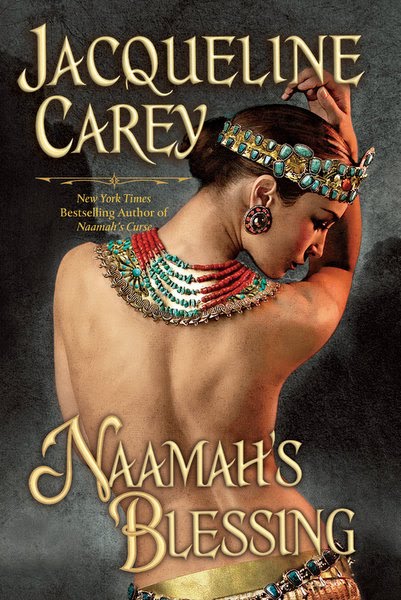
Exclusive excerpt from Jacqueline Carey's NAAMAH'S BLESSING


As we did in years past, Jacqueline Carey was kind enough to supply an exclusive extract from her forthcoming Naamah's Blessing to share with her legions of fans. For more info about this title: Canada, USA, Europe.

Here's the blurb:


Returning to Terre d'Ange, Moirin finds the royal family broken. Wracked by unrelenting grief at the loss of his wife, Queen Jehanne, King Daniel is unable to rule. Prince Thierry, leading an expedition to explore the deadly jungles of Terra Nova, is halfway across the world. And three year old Desirée is a vision of her mother: tempestuous, intelligent, and fiery, but desperately lonely, and a vulnerable pawn in a game of shifting political allegiances.

As tensions mount, King Daniel asks that Moirin become Desirée's oath-sworn protector. Navigating the intricate political landscape of the Court proves a difficult challenge, and when dire news arrives from overseas, the spirit of Queen Jehanne visits Moirin in a dream and bids her undertake an impossible quest.

Another specter from the past also haunts Moirin. Travelling with Thierry in the New World is Raphael de Mereliot, her manipulative former lover. Years ago, Raphael forced her to help him summon fallen angels in the hopes of acquiring mystical gifts and knowledge. It was a disastrous effort that nearly killed them, and Moirin must finally bear the costs of those bitter mistakes
.


Enjoy!


---------------------------

I did not expect kindness.

In that, I was mistaken. The Emperor Achcuatli gazed at me long and hard when I was escorted once more into his presence, and there was desire in his gaze, but there was also a gentleness he hadn’t shown before. At length, he smiled. “It is pleasing to see you dressed in my gifts.”

I bowed. “They are very beautiful, my lord.”

He gestured to a chair across the table from him. “Come, sit. We will take chocolatl.” At that, I must have brightened, for he laughed. “You know it?”

I sat opposite him. “Yes, my lord.”

While attendants prepared the frothy concoction, sweetening, spicing and whisking it, Achcuatli studied me. “You are not scared or—“ The second word was unfamiliar. Naamah may have graced my tongue, but not my vocabulary; at least not in a permanent manner.

“No, my lord. I am not scared,” I said. “I do not know the other word.”

Achcuatli pressed a fist to his belly. “To feel sick inside at an unclean thing.”
The image of the skulls flashed before my eyes again, and once again, I pushed it away. “There are things about the Nahuatl I find... hard to understand,” I said slowly, chosing my words with care. “Desire is not one of them. It is a sacred thing to my father’s people.”

His obsidian eyes were intent. “Is that why it is so strong in me for you?”

Attendants set golden goblets of foamy chocolatl before us. I waited for the Emperor to drink before taking a sip, reveling in the wondrous mixture of bitterness and sweetness, the rich taste of it. “Yes.”

“A sacred thing,” he mused.

I took another sip. “I am a child of the goddess Naamah, to whom all desire is sacred.”

Achcuatli’s mouth twisted. “The men of Aragonia would have had us believe they were gods, too.”

I shook my head. “I do not say that. Only that Naamah is—“ I didn’t know the word for ancestor. “My father’s hundred-times ago mother.”

His face cleared. “I see. Yes, such things are known.”

“Did you think it was true?” I asked. “About the Aragonians?”

“No.” The Nahuatl Emperor was silent a moment. “I knew they were men. They fight and bleed and die like men. But I thought their gods had favored them, giving them knowledge to build great ships that cross the sea, giving them armor against which our macahuitls shattered and broke, and great beasts to master and ride. And so I let them stay. I was young, and knew no better.”

It was on the tip of my tongue to ask why he did not send them away now, but not wanting to provoke a diplomatic incident, I did not voice it.

Achcuatli guessed anyway, giving me a shrewd look. “Now it is too late. There are too many to defeat with ease, and they have made bargains with other people, tribes we have conquered, who would be pleased to see this empire fall. Foolish people, who think the men of Aragonia would keep their bargains.”

Once again, I held my tongue, grateful that I’d learned a measure of discretion.

And once again, he knew. “You do not wish to speak against them,” he observed. “That may be wise. But I know what they wish. If they could defeat us and rule over this empire, they would.” He shrugged. “I know what they say. They think their Nahautl servants are too stupid to learn their tongue, and we have let them think it. They speak freely before their servants. They think we are little better than animals.”

“I do not think that,” I said.

“No.” Achcuatli considered me. “You are different. And yet, Cuixtli tells me the sight of the tzompantli sickened you.”

“Yes.” I didn’t need to know the word to guess it referred to the rack of skulls. And while I didn’t want to give offense, I thought it best not to lie when doing Naamah’s business. “It did.”

The Emperor drained his goblet. “Come,” he said. “I wish to show you something.”

Obediantly, I rose to accompany him. Attendants hastened to brush the ground before our path. Achcuatli dismissed them from the task with mild irritation. I noted that he’d exchanged his gold-soled sandals for more practical plain ones, and thought that the Nahuatl Emperor also knew a good deal about the value of appearances.

Followed by a discreet throng of attendants and guards, we exited the palace into an extensive pleasure garden, one so vast and ornate it made me catch my breath. There were oak trees, cypresses and palms, and others I could not identify with thick barrels and wide, spreading leaves. There were countless flowers in a riot of color. All of them were healthy and vibrant, reaching exuberantly toward the sun. I breathed the Breath of Trees Growing, drinking in the green scent of the place.

Achcuatli led me toward a large structure. At a distance, I thought it a gazebo of sorts, but as we drew nearer, I saw that it was an aviary built of wood and wicker, filled with growing trees. There must have been a hundred birds inside it. I hadn’t seen such brilliant plumage since leaving Bhodistan.

“See there?” He pointed to a bird with emerald green feathers and a ruby breast. It perched on a branch, regarding us with big round eyes. Splendid green plumes as long as my forearm trailed from its tail. “That is the quetzal. It is a sacred bird.”

I glanced at Achcuatli’s headdress, recognizing the plumes, and lifted one hand involuntarily to touch the feathers on my own.

“Yes,” he said as though in answer to an unasked question. “It is an honor to wear them.”

“You are kind.”

Achcuatli touched my cheek, a feather-light touch. Even so, I felt a spark of desire leap between us. It was the first time he had touched me. “I would have the world know that the Nahuatl know how to honor a woman.”

“I will tell them,” I said.

His black eyes glinted. “Good.”

When he withdrew his hand, I felt a pang of loss; and at the same time, a pang of guilt, thinking of Bao. But Naamah’s gift enfolded me, assuring me that I was doing her will. I put my guilt aside. Later, there would be time to confront it.

As if the aviary wasn’t impressive enough, there was a bestiary, too. Upon visiting it, Achcuatli stood for a long time before a cage that contained a pair of immense spotted cats that paced back and forth, lashing their tails. Now I knew where Temilotzin’s hides came from. Brushing their thoughts, I felt a mixture of boredom and frustration.

“Some days I feel like them,” Achcuatli said at length. “Trapped in a cage I did not make.”

“So free them,” I murmured.

He shook his head. “It would be a terrible omen.”

I wondered at the Emperor speaking so freely to me; but then, betimes it was easier to confide in a stranger. And I was a foreigner. I would not think less of him for revealing he did not possess a stone face and a stone heart. Indeed, quite the opposite.

We left the bestiary to stroll the garden. As odd as the situation was, I couldn’t help but take pleasure in the lush greenery. Achcuatli paused before a bed of vivid dahlias, stroking their intricate petals with one finger.

“Greet the sky and live, blossom!” he said unexpectedly. “Yet even as the wind stirs your petals, flowers fall. My flowers are eternal, my songs live forever. I lift them in offering; I, a singer. I cast them to the wind, I spill them. The flowers become gold, they come to dwell inside the palace of eternity.”

Something in the words caught at my heart. “Is that a poem?”

“Yes. It is part of a famous poem.” He met my gaze. “It is in honor of life and death. Your people honor life, but they do not honor death.” He broke the stem of a purple dahlia, lifting the blossom. “To me, the skulls in the tzompantli are no different from this flower, and are as beautiful in their own way.”

I took a long, slow breath. “I am trying to understand, my lord. But the flower does not feel pain. The flower does not bleed.”

Achcuatli nodded gravely. “And that is why the flower’s death is not enough to feed the gods. Blood is needed.”

I looked away. “What if you’re wrong?”

He touched my hair. “Who are you to teach the Nahuatl about their own gods?” For a mercy, he sounded more amused than offended.

“A child of my mother’s people,” I said in a low tone. “Who lost a great gift because we did not understand the will of our god. One who has seen for herself that men try to shape the gods’ will to serve them.” I thought about Raphael de Mereliot. “One who did the same when she was young.”

Achcuatli chuckled. “You are still young.”

Without looking at him, I laid a finger on the tightly furled bud of an unopened dahlia blossom. Summoning the merest hint of the twilight, I exhaled softly and coaxed it to grow. It opened obligingly, its myriad petals unspiraling to reveal a crimson blossom with a yellow center.

Beside me, the Nahuatl Emperor drew a sharp breath.

I glanced up at him.

His eyes were narrowed. “What are you?”

“Myself,” I said simply.

Beneath the thin veneer of stoicism, warring emotions crossed his mien. Without warning, he seized my face in his hands and kissed me hard, his tongue thrusting past my lips, the gold plug in his chin digging into mine. Just as quickly, he released me and took a step backward.

“I must think.” Achcuatli beckoned to the entourage trailing us. “My servants will return you to your chamber. I may send for you tonight, or I may not.”

I inclined my head, knowing he would.

New Steven Erikson Q&A


As we await our own interview with Steven Erikson, author of The Crippled God (Canada, USA, Europe), the folks at Elitist Book Reviews just posted their own Q&A. Here's an excerpt:

For me writing is an exercise in humility. It always astonishes me when I prowl the hate-box (funny how the internet was meant to be a love-box, only to have it increasingly sway in the opposite direction … well, not funny. Disturbing) and read from fans of the genre comments on my coming across as arrogant, either in interviews or in my fiction. For my own sanity I can only assume that by subverting the tropes of the genre in my fantasy fiction, I am somehow perceived as attacking the lovers of the genre, which I am emphatically not doing. I grew up reading and loving the same stuff they’re now reading: but as a writer I wanted to twist it a little, do something different, and avoid the lazy route of reiterating what other writers have already done. This has landed me in the occasional shit-storm, where fans in their tribes feel it necessary to put down other writers in order to build up their favorite writers. Uhm, it’s not a competition, mates, and when I’m being judgmental, it’s self-directed. As writers we each participate to make up the whole genre, and it’s a big, flexible genre. For myself, I do hope that fans of my work read and enjoy as much fantasy fiction as is out there, and to forever remain open to new voices; and, most importantly, to not feel threatened by new takes on the genre. You lose nothing by being open-minded and you lose everything when you shut the door, bolt the lock, and hide from every challenge.

Follow this link to read the full interview.

Game of Thrones: Sneak Preview


The first 14 minutes of the first episodes!

Only a few more days now. . . =)

Win a copy of Peter Orullian's THE UNREMEMBERED


I have three copies of Peter Orullian's eagerly anticipated fantasy debut, The Unremembered, up for grabs, compliments of the kind folks at Tor Books! For more info about this title: Canada, USA, Europe.

Here's the blurb:

The gods, makers of worlds, seek to create balance—between matter and energy; and between mortals who strive toward the transcendent, and the natural perils they must tame or overcome. But one of the gods fashions a world filled with hellish creatures far too powerful to allow balance; he is condemned to live for eternity with his most hateful creations in that world’s distant Bourne, restrained by a magical veil kept vital by the power of song.

Millennia pass, awareness of the hidden danger fades to legend, and both song and veil weaken. And the most remote cities are laid waste by fell, nightmarish troops escaped from the Bourne. Some people dismiss the attacks as mere rumor. Instead of standing against the real threat, they persecute those with the knowledge, magic and power to fight these abominations, denying the inevitability of war and annihilation. And the evil from the Bourne swells….

The troubles of the world seem far from the Hollows where Tahn Junell struggles to remember his lost childhood and to understand words he feels compelled to utter each time he draws his bow. Trouble arrives when two strangers—an enigmatic man wearing the sigil of the feared Order of Sheason and a beautiful woman of the legendary Far—come, to take Tahn, his sister and his two best friends on a dangerous, secret journey.

Tahn knows neither why nor where they will go. He knows only that terrible forces have been unleashed upon mankind and he has been called to stand up and face that which most daunts him—his own forgotten secrets and the darkness that would destroy him and his world
.

The rules are the same as usual. You need to send an email at reviews@(no-spam)gryphonwood.net with the header "UNREMEMBERED." Remember to remove the "no spam" thingy.

Second, your email must contain your full mailing address (that's snail mail!), otherwise your message will be deleted.

Lastly, multiple entries will disqualify whoever sends them. And please include your screen name and the message boards that you frequent using it, if you do hang out on a particular MB.

Good luck to all the participants!

A bit of humor. . .


A Darth Vader ice cream delivery truck!?!

Good spoof from the guys at ThinkGeek!

New interview with Ian Cameron Esslemont


Don't know how I missed this one a few weeks back. . . :/

There is a new Q&A with the Malazan co-creator and author of Stonewielder (Canada, USA, Europe) with the folks at Elitist Book Reviews. Here's an excerpt:

As I mentioned, Orb Sceptre Throne will be out next. It is set in Darujhistan and follows up on Toll the Hounds quite closely. It is thus more or less contemporaneous with Stonewielder. Right now I am working on the next of the series, which follows events unfolding upon the continent of Jacuruku. The working title for this novel is City in the Jungle. After this (everything having worked out) I hope to tackle the final work of the main arc, which is titled, Assail. That is the main sequence for Malaz. If I somehow find extra time there are SF projects I’ve had my eye on for some time now. I can only hope.

Follow this link for the full interview with Ian Cameron Esslemont!

This week's New York Times Bestsellers (March 29th)


In hardcover:

Patrick Rothfuss' The Wise Man's Fear is down two positions, ending the week at number 5. For more info about this title: Canada, USA, Europe.

Deborah Harkness' A Discovery of Witches is down two spots, finishing the week at number 8. For more info about this title: Canada, USA, Europe.

Patricia Briggs' River Marked is down four spots, finishing the week at number 13.

Kim Harrison's Pale Demon maintains its position at number 19.

Jasper Fforde's One of our Thursdays is Missing is down six positions, ending the week at number 21. For more info about this title: Canada, USA, Europe.

In paperback:

Jim Butcher's Changes is down three spots, finishing the week at number 14.

Peter Straub's A Dark Matter debuts at number 17.

Max Brooks' World War Z: An Oral History of the Zombie War returns at number 22 (trade paperback).

Patrick Rothfuss' The Name of the Wind is up two spots, finishing the week at number 24.

John Barnes' Directive 51 debuts at number 32.

Childe Morgan


A fan of the series for over two decades, it's always with great pleasure that I return to the Deryni universe. Now 40+ years in the making, Katherine Kurtz's landmark series seldom fails to satisfy. Sadly, though she is likely the mother of historical fantasy, over the years the NYT bestselling Deryni saga has become out of print and thus a bit harder to find. Which means that an entire generation of SFF readers have yet to get acquainted with this classic sequence of books.

Moreover, other than the the very first trilogy (which, truth to tell, is perhaps the weakest in the saga) being reissued recently, what Deryni novels still in print (King Kelson's Bride, In the King's Service, and Childe Morgan) are more or less meant to bridge various gaps in the saga's timeline instead of focusing on new storylines that could perhaps entice new readers to plunge into the Deryni universe and fall in love with it and the great characters that populate its history.

Having said that, as a direct sequel to In the King's Service, Childe Morgan is sure to please Katherine Kurtz's fans awaiting new Deryni adventures. The events chronicled in this novel span a period of approximately two and a half years, covering Alaric Morgan's early childhood and what will lead to Kurtz's first trilogy.

Here's the blurb (patched from a Wikipedia entry, since the official blurb is nowhere to be found online):

The novel is set in the land of Gwynedd, one of the Eleven Kingdoms. Gwynedd itself is a medieval kingdom similar to the British Isles of the 11th century, with a powerful Holy Church (based on the Roman Catholic Church), and a feudal government ruled by a hereditary monarchy. The population of Gwynedd includes both humans and Deryni, a race of people with inherent psychic and magical abilities who have been persecuted and suppressed for almost two centuries. The novel details the early life of Alaric Morgan, a half-Deryni child chosen by King Donal Blaine Haldane to protect the royal legacy of arcane magic. However, Alaric is scorned by both humans and Deryni for his heritage, some of whom will stop at nothing to destroy the young boy.

As a prequel to The Deryni Chronicles series, like its predecessor Childe Morgan covers a lot of ground, paving the way to the book which started it all, Deryni Rising, about twenty-five years in the future. Familiar themes such as Mearan rebels, the Camberian Council's machinations, Torenthi incursions into Gwynedd, the Church's hatred toward Deryni, the separation between Church and State, and a monarch desperately attempting to protect his lineage feature quite prominently in this novel.

Kurtz's historian eye for details makes for beautiful and vivid worldbuilding. The richness of details and her depiction of medieval life creates an imagery which brings the world and its protagonists to life.

And yet, although Katherine Kurtz's worldbuilding skills are on par with gifted fantasy authors such as Steven Erikson, George R. R. Martin, Robert Jordan, and R. Scott Bakker, it's the characterization which elevates her books over that of the competition and makes the Deryni Saga one of my most beloved series of all time. Not unlike Robin Hobb and Guy Gavriel Kay, Kurtz's subtle human touch can pull on those heartstrings when you least expect it. Damn her, but Kurtz managed to make my eyes water again! Few writers have the ability to create such genuine characters that you come to care about the way Katherine Kurtz can, seemingly effortlessly.

As was the case in In the King's Service, Lady Alyce de Corwyn takes center stage. Sir Kenneth Morgan, as Alaric's father, and King Donal Blaine Haldane, understandably, also have important roles to play. I have to admit that it was quite amusing to see Duncan McLain and Alaric Morgan, two of the most important power players in the struggle to come, as mischievous children playing in the mud!

Amid all the politicking, there are a number of poignant moments in Childe Morgan, especially in every scene featuring Sir Sé Trelawney, childhood friend of Lady Alyce and now a fully avowed Knight of the Anvil. Somehow, this character manages to steal the show every time he's present, even though it's done in a very subtle manner.

The pace is fluid throughout, the narrative fleshes out details we've been waiting for years to see unveiled. All too quickly, the end comes, with no other Deryni installment in sight for the near future.

The final verdict: 7.75/10

For more info about this title: Canada, USA, Europe

As I mentioned before, I encourage everyone to give the Deryni Saga a shot. Believe you me: You won't be disappointed! Get it from the library, or buy it for peanuts via the links below or at used bookstores. But read it! For the best results, start with The Legends of Camber of Culdi, followed by The Heirs of Saint Camber. If it's youe cup of tea, you'll need no encouragement to read the rest of the Deryni Saga!

The Chronicles of the Deryni

- Deryni Rising (Canada, USA, Europe)

- Deryni Checkmate (Canada, USA, Europe)

- High Deryni (Canada, USA, Europe)

The Legends of Camber of Culdi

- Camber of Culdi (Canada, USA, Europe)

- Saint Camber (Canada, USA, Europe)

- Camber the Heretic (Canada, USA, Europe)

The Histories of King Kelson

- The Bishop's Heir (Canada, USA, Europe)

- The King's Justice (Canada, USA, Europe)

- The Quest for Saint Camber (Canada, USA, Europe)

The Heirs of Saint Camber

- The Harrowing of Gwynedd (Canada, USA, Europe)

- King Javan's Year (Canada, USA, Europe)

- The Bastard Prince (Canada, USA, Europe)

King Kelson's Bride (Canada, USA, Europe)

In the King's Service (Canada, USA, Europe)

Childe Morgan (Canada, USA, Europe)

Deryni Anthologies

- The Deryni Archives (Canada, USA, Europe)

- Deryni Magic (Canada, USA, Europe)

- Deryni Tales (Canada, USA, Europe)

For more information about this genre-defining historical fantasy series, check out the wikipage devoted to the Deryni saga.

Musical Interlude


Because it's that kind of morning. . .