Katherine Kurtz interview

I know this one was a long time in coming, but here it is!;-)

Katherine Kurtz's Deryni saga is one of my favorite fantasy series of all time. I was thus very excited when I was able to secure an interview with the author last spring. Her moving back to the USA in the intervening months postponed this Q&A for a while, yet I'm happy to finally bring it to you!

For those of you who think that GRRM is taking forever to write the next volume of A Song of Ice and Fire, know that Kurtz has been at it since 1970 with the Deryni saga, and it remains unfinished. Sadly, other than a scant few, not many people among the new generation of SFF readers have read this series. Here's to hoping that this interview will pique your curiosity enough to give it a shot. . .:-) Please be forewarned that this Q&A contains a couple of spoilers.
For those who wish to learn more about Katherine Kurtz and her novels, check out www.deryni.net.

Enjoy!
--------------------------

- At this point, how many Deryni novels do you foresee will be required to bring the saga to an end? Have you abandoned the idea of one day managing to write all the Deryni books you envisioned when you started working on the series?

Actually, I don’t so much see an end to the saga as a filling in of blank spots within what I’ve already written. I’m working on the third Childe Morgan book now; but when I finish that-which may or may not actually bring us up to right before the beginning of Deryni Rising-I will probably do the book that covers the events of 948, when so many of our favorite characters die. (Of course, some of them are pretty old by then, so that’s OK.) After that….maybe the story of Orin and Jodotha? Or I might do a tale of Torenth….or the Anvilers. I’ve told several short stories from the other side’s perspective, and rather enjoyed it.

- At the time when THE BASTARD PRINCE was released, you were probably at the height of your popularity. At that point you elected to turn your attention to other writing endeavors. In retrospect, with the Deryni saga being what it was then, would you do it again? Do you feel that you needed to concentrate on other works at that juncture in your career?

I think what has kept the Deryni series fresh-for me, at least, if not all of my readers-is that I have branched out to do other things, given myself rests from the Deryni. I’ve even given myself rests from my characters, by alternating between the characters of Kelson’s time and those of Camber’s time. (And when I wrote Lammas Night, the first non-Deryni novel, it was partially to prove to myself that I could sell things besides medieval fantasy. Who would have guessed that John Graham would later be part of the inspiration for the Adept series?-which I’ve enjoyed immensely.) Besides that, it’s been fun doing other things-so yes, I’d do it again.

- Will you soon be revisiting the characters and events introduced in both The Legends of Camber of Culdi and The Heirs of Saint Camber trilogies?

That would be the book set in 948.:-)

- Some Deryni titles appear to be out of print. Is that the case? If so, have the rights been sold to a new publisher?

For the most part, the books haven’t been out of print; just harder to find. But every time a new one comes out, that’s encouragement for the publishers to re-release previous ones. I believe that’s part of the strategy on the part of Ace to let me do the "author’s cuts" of the first three books-and also to finally make them available in hardcover, since they were originally paperback only, in the dim, dark ages when modern fantasy was just being invented, and no one was sure whether it would fly beyond Tolkien. And yes, I moved publishers with King Kelson’s Bride. I believe it’s Ace’s intention to gradually acquire the rights to all the Deryni series and build up a substantial backlist, in addition to the Adept and Templar books.
- What's next for King Kelson and company?

I’m not certain that I’ll go beyond King Kelson’s Bride, time-wise. He eventually got the right girl, and hopefully they will all live mostly happily ever after. (It didn’t particularly work for Dorothy Sayers, when she tried a story about Lord Peter Wimsey and Harriet Vane after they’d married and produced an heir; but maybe she was generally running out of steam by then.) But another reason I probably wouldn’t do a post-KKB book is because the anti-Deryni menace is becoming increasingly resolved by then-and conflict is part of what makes a good story. Now, 948…

- DERYNI RISING was first published in August 1970. How rewarding is it to realize that you're still around and that interest for the Deryni saga remains to this day?

It’s immensely rewarding-and having had the chance to go back and tweak it for the hardcover edition was a real eye-opener for me, looking back at where I started and contemplating where it all has gone. Who would have thought? One can definitely see that I was not only learning my craft but defining my genre-indeed, helping define the whole historical fantasy genre that now exists. And they’re still damned good first novels. But I’d started to hit my stride by Camber of Culdi; and the rest, as they say, is history. What’s particularly gratifying is that the early books, in particular, got a lot of kids to start reading. A fourteen-year-old protagonist is very attractive to kids in junior high-and Harry Potter was still far in the future.

- What do you feel is your strength as a writer/storyteller?

I would have to say that it’s characterization, and the ability to evoke richly textured visual images. And I suppose I do have a devious mind for convoluted plots.

- Have the plotlines diverged much since you began writing the Deryni series, or did you have the entire plot more or less figured out from the very beginning? Were any characters added or further fleshed out beyond your original intention? Have you made any changes to your initial plans during the course of the writing of the series?

When I first started out, I had no game plan beyond the first three books-though by the end of that first trilogy, I certainly had Camber firmly in mind, and knew I had to write a book about him. Of course, that one-book notion lasted about two thirds of the way through CC, when I realized that all of Camber’s story wasn’t going to fit into a single volume. And I think I only got about halfway through SC before I realized that I was going to need a third book about him. Even then, his story wasn’t really finished-which was when it became clear that I was actually telling an ongoing saga. For me, at least, writing is an evolutionary journey, and where you think you’re going may not be where you actually end up; sometimes characters have better ideas than the writer does. This is not to say that one ought to let characters run away with the story, but it is a good idea to listen to them from time to time.

- Characters often take a life of their own. Which of your characters did you find the most unpredictable to write about?

It wasn’t characters so much as incidents. I would have to say that there have been several characters who have occasionally done things that I hadn’t planned-though in hindsight, the incidents have always been ones where, after I’d written that passage, I’d say to myself, "Of course that’s how it had to happen. What was I thinking before?"

One of the most striking examples is when Cinhil opens that chest in his room, after an assassin has tried to kill him, and we learn that he’s been squirreling away vestments and other Mass accoutrements, that he hasn’t really given up his priesthood as he was instructed to do-but of course that’s what he was doing. How could he have done anything else, and still been true to himself? But as I was writing that scene, I didn’t consciously know that. As he’s walking across the room, looking at the chest and then kneeling to open it, I’m thinking, "Why is he walking over to that chest? What is in that chest that’s so important?" But he knew-and when the chest opened, all became clear. Another example is when Teymuraz suddenly turns on Morag and kills her, toward the end of KKB-whoa, I hadn’t seen that coming! But how else could that scene have played out, given the two individuals?

- Were there any perceived conventions of the fantasy genre which you wanted to twist or break when you set out to write the Deryni series?

LOL, good gracious, no! I just wanted to tell the kind of story that I liked to read, because in those days, there wasn’t enough out there to my taste. (The old adage of "Sometimes you have to do it yourself" is certainly true.) In the first book, I thought I had to follow certain conventions, like rhyming spells, and magical beasts, and the like, for it to be fantasy-but by the time I’d done the first three books, and they were selling well, and I was finding my voice as an author-I decided that maybe I didn’t have to follow the "classic" guidelines. There was a whole universe out there to be explored.

- What was the spark that generated the idea which drove you to write the Deryni series in the first place?

It was a dream, Honest! I still have the 3x5 cards on which I jotted the notes right after I woke up. A few things changed in the course of developing the outline for what became DR, but it’s pretty much all there. Interested readers can look at a transcription of those original notes, the unpublished short story/novella that was later expanded into parts of Deryni Rising, and the original outline that sold the first trilogy in The Deryni Archives, which also contains the first few short stories I wrote in the Deryni universe.

- What would you say was/is the hardest part of the entire process involved in the writing of the Deryni series? Each new addition reveals yet more depth to a series which has shown just how rich and complex it truly is.

I don’t know that I can pin down the hardest part. Some parts of some books are just harder than others, and there’s no way to predict, in advance, what those will be. But part of the enjoyment of the creative process is figuring out the puzzle. Resurrecting Camber, after I’d said he was dead, was a challenge-but I can’t use that device again. Having Dhugal turn out to be Duncan’s son, while still preserving everyone’s honor, was also a challenge. And there were others, of course. As long as I still get to resolve puzzles, I’ll probably keep writing the series for as long as I can.

- For obvious reasons, many authors steer clear of religion. And yet, you have made religion an integral part of the tale. Was that a deliberate choice right from the beginning?

I’ve always been interested in religion and the history of religion, especially Christianity. When I wrote Deryni Rising, I wasn’t sure one could go there-and if you look at the original edition, I really hedged my bets, and was careful not to be too specific about the religious aspects. And yet, what was being reinforced in my graduate studies in history was that in the real middle ages, religion was inextricably interwoven with everything else that was happening, and permeated virtually every aspect of life-and like so many other forms of power, religious power was sometimes corrupted. So I got bolder in DC, and bolder still in HD-and I knew that there was this Saint Camber guy who had to have his story told.

- What extensive research did the writing of the Deryni saga entail?

Well, I have an MA in history, so I’d already done a lot of that-and knew how to do it. As for the rest, one delves deeper when there’s a specific need-like deciding to use a corruption of minution-blood-letting designed to help monks suppress their bodily passions-so that it became a weapon in the hands of unscrupulous men who justified what they did in the name of religion. And of course I did research before writing an excommunication scene, for example. Part of the challenge is interweaving these things into context, so that the flow of the story isn’t interrupted. I try to avoid information dumps; but I do try to leave my readers knowing more about a subject than they did before. An author’s first job is to entertain, to tell a damned good story; but if you can also open minds and educate along the way, that’s an added bonus.

- In light of the current market, are you tempted to write one of those enormous fantasy epics which continue to be the most successful series at the moment?

Er, am I not already writing a multi-volume epic fantasy?-and began doing it before most other writers had really thought about it. Tolkien was the first, of course-and between the two of us, we apparently managed to convince an entire generation of writers that trilogies were the only way to go. But it isn’t. It’s astonishing to me that so many aspiring writers think they have to write a trilogy. That’s a big bite for folk who’ve mostly never even managed to complete a short story in coherent form. I don’t mean that to sound harsh, but too often young writers get wound up in creating a world, and do that at the expense of learning how to create compelling characters who can speak in believable dialogue. There’s a definite place for stand-alone novels-says the woman whose books almost all touch on a very few common threads.

- Is a World Fantasy Award something you covet?

It would be nice, certainly-and awards do tend to give a book exposure that leads to more sales, so that’s a definite plus. But I don’t write for the awards. I write because it pleases me, and because I get antsy when I’m not writing and putting ideas together. These last couple of years, when I was heavily involved with finishing the restoration of our house in Ireland and getting it to market, the original writing suffered, though I did manage to turn out Childe Morgan, and am happy with the result. But fortunately, the general chaos coincided with the polishes for the hardcover re-releases of the first three books-the "author’s cuts," if you will-which I could pick up and put down without losing continuity. (I was also been working with my Scottish writing partner, Deborah Turner Harris, on the outline for a new Adept book, a prequel to the five we’ve already done-and that is now getting underway. And of course, the third Childe Morgan was bubbling away on a back burner.) So even in the midst of chaos, the writing goes on, in one form or another. And now that I’ve just about found the floor in my new office, and my new bookshelves and desk units have been installed, I can get back to work on that third Childe book! (When we first moved back to the States, earlier this year, we lived in a hotel for more than two months, before our house was ready to move in-and I reviewed the copy-edits for High Deryni while holed up in the hotel room, and had to rely on the hotel business center for my internet access. This was not conducive to getting much serious writing done!)

- What project will you be tackling next? What's the progress report?

I’ve begun work on the third Childe Morgan-still uncertain what it will be called. Hopefully it will go fairly quickly. Meanwhile, the High Deryni hardcover will be out for Christmas of this year.

- Honestly, do you believe that the speculative fiction genre will ever come to be recognized as veritable literature? Truth be told, in my opinion there has never been this many good books/series as we have right now, and yet there is still very little respect (not to say none) associated with the genre.

Well, J.K. Rowling certainly did her part to put fantasy on the popular map. Granted, the Harry Potter books are regarded as children’s literature-but I reckon that at least as many adults as children have read the books, and loved them. And while some adults may still sneer at fantasy, there’s no denying that it has made Rowling one of the richest women in Britain-and one of the most respected, since she applies a large portion of her wealth to good causes, like children’s literacy. There’s no arguing with that sort of success-and by association, I think fantasy probably has acquired a bit more acceptance. A number of science fiction properties have also helped to raise public awareness of speculative fiction as a worthy literary genre, by being translated into the more popular medium of film. After all, you can’t have films without authors.

- How would you like to be remembered as an author? What is the legacy you'll leave behind?

I know that many of my readers have found inspiration in my books for dealing with troubling aspects of their real lives, and that the books sometimes have made big differences in how those readers have coped with difficult times. Some would call it a spiritual dimension that they had thought lost. That can only be a good thing. I know that my readers generally learn things from reading my books-and to learn is always a good thing, especially if it’s nothing like the formal lessons one remembers-or doesn’t remember!-from school. But most of all, I hope that my readers come away from their reading of my work with a greater awareness that being different is not necessarily wrong. As I’ve often summed up my intention, "I don’t necessarily want to change minds; just open them."

Top 10 tips for plagiarists

Thanks to MinDonner who runs the excellent www.sandstormreviews.blogspot.com for posting this on Westeros:

Self-published author puts out carbon copy of Gemmell's Dark Prince, claiming firstly that she spent two years slaving over it, then saying her "ghost-writer" did it and she didn't know, then starts shouting about legal retribution and Wiccan tenfold punishments on all teh internets...

Check it out here.

Hmmm, I think I have to call Matt to let him know that he was right after all, and that we might want to reconsider naming my three main characters Rand, Mat and Perrin. . . And that braid-tugging girl will probably have to go. . . Damn, more rewrites ahead!:p

Quote of the day (This one's for my French readers)

Hi coquine, ça farte!?!

- BRICE DE NICE
(Un p'tit clin d'oeil pour mes lecteurs et lectrices francophones!;-))

The Privilege of the Sword

I didn't buy this book when it was initially released because it appeared to be a sure miss for me. Then followed praise and rave reviews, and still I declined to pick it up. It is only when it was nominated for the World Fantasy Award that I finally caved in. Given the fact that I don't always agree with the WFA nominations, and even more seldomly with the winners, I should have known better. . . In a way, I brought this upon myself. . .

I am acutely aware that some will grill me for saying this, but Ellen Kushner's The Privilege of the Sword is, in my humble opinion (which doesn't count for much, as some will surely point out!), fantasy chick lit. I'm all for strong and genuine female protagonists, yet this is one of the "girliest" novels I've ever read. Needless to say, this book didn't do it for me. I'm not implying that male readers won't enjoy it (many already have, with more to come, I'm sure), but, personally, I found it completely impossible to connect with the characters and the paper-thin plot underlying this tale.

On the upside, Kushner's prose is excellent. The author writes her narrative economically and skillfully. The Privilege of the Sword is as well-written as it gets. Still, as good as the prose is, it cannot possibly make a boring and predictable story any better.

There is no worldbuilding to speak of. This novel reads more like an alternate history book than a fantasy tale. Unfortunately, it lacks that breadth of details that an author like Guy Gavriel Kay brings to the table.

The characterization is the aspect which leaves the most to be desired. Artemisia and Lydia rank among the most insufferable, whiny, vapid, harebrained and soporific characters in the history of the genre. The main character, Katherine, never truly takes center stage, and thus she never really has the ability carry this story along. The sole interesting character is the Mad Duke Tremontaine, but he never lives up to his apparent potential.

I refer to this book as fantasy chick lit because it contains several elements that are associated with "chick lit." There's a very "girly" approach to the narrative. It focuses on undying/forbidden love, corny romance, flowers, jewelry, gowns, fabrics, and an inordinate amount of emo moments. For crying out loud, the characters shed more tears in this book than bridesmaids at a wedding! There is only so much crying one can take, after all. In addition, the emo male characters are not authentic.

The Privilege of the Sword is supposed to be a coming-of-age tale that is hip and edgy. Original? Well, we've seen it all before, I'm afraid. The gender role-reversal was done by Robin Hobb in the Liveship Traders series, and Althea was a much more believable and genuine character than Katherine could ever hope to be. Edgy? Why, because it contains girls kissing girls and men having sex with other men? Gay and bisexual characters make The Privilege of the Sword edgy? Perhaps I'm too avant-garde, but not in this house. I kept plodding on, reading more and more, desperately hoping that I would finally grasp what made this book such a favorite among many SFF fans. But the more I read, the worst it got. I guess that Ellen Kushner's brand of storytelling just isn't for me. . . To each his own, as they say!

The plot is as linear and straightforward as it gets. I was never drawn into the story, period. No convoluted and multilayered storylines comprise this tale. It moves in a fluid yet highly predictable rhythm.

I know that many will disagree with me, yet as far as I'm concerned, this is one of the most overhyped novels I've ever read.

Disappointing. . . And no, I will not be reading Swordspoint. . .

The final verdict: 6/10

For more info about this title: Canada, USA, Europe

J. V. Jones contest winners!

The names of our winners have been drawn. Each will receive a brand new copy of J. V. Jones' latest, A Sword from Red Ice, complimets of Tor Books and Orbit.

The winners are:

- Matt Westphal1, from Milwaukee, Wisconsin, USA

- Charles Jackson, from Kanata, Ontario, Canada

- Kim Clemens, from Pittsburgh, Pennsylvania, USA

- Michal Jakuszewski, from Podrzeczna, Poland (Bastard of Godsgrace on asoiaf.westeros.org)

- Kim Olofsson Norrgård, from Tormestorp, Sweden

- Sini Neuvonen, from Helsinki, Finland

Thanks to all the participants!

Patrick Rothfuss contest winner!

The name of our winner has been drawn. Thanks to the nice folks at Gollancz, that lucky person will receive a copy of the UK edition of Patrick Rothfuss' fantasy debut, The Name of the Wind (Canada, USA, Europe).

The winner is:

- Kuido Talu, from Parnu, Estonia

Thanks to all the participants and stay tuned for more!;-)

An interview with Yours Truly!;-)

A few days ago, I received an email from Scott from http://www.fantasylibrary.blogspot.com/. He wanted to know if I'd be willing to be interviewed, with questions ranging from my love of fantasy to the evolution of this little blog of mine. I said yes, of course! And the full Q&A can now be found here.

We discussed a variety of topics, including my writing endeavors, as well as how the Hotlist saw the light and became what it is today -- two subjects many of you appear to be interested in, at least judging by the number of emails I receive pertaining to all this!;-) Add to that Playboy parties, midget sex clips, absinthe, and more, and you have something that hopefully won't put anyone to sleep!:p

Remember to go easy on me, guys. This is my first interview, after all!

Fantasy, Romance and The Effects of the Female Demographic

Considering that my calling Ellen Kushner's The Privilege of the Sword fantasy chick lit on Westeros spawned a heated debate, I'm wondering what many will make out of this latest post by the controversial Jonathan McCalmont.

Here's a brief sample:

Reasons for Optimism

Firstly, I am not certain that there is such a thing as "female tastes". I've never been comfortable with the feminist thought attacking science because it always struck me as sexist to suggest that women can't do abstract thought and science or that they're better off thinking about relationships and fashion. Surely these are arbitrary tastes foisted upon us by society? Most young female fantasy fans will never have read romance literature, so where could they have acquired a disinterest in the more logocentric aspects of genre? what attracted them to the genre in the first place?

Secondly, it's not clear in which way the bad stuff in fantasy and fantasy's dominance are reducible to stereotypically female characteristics. The lack of interest in abstract and scientific ideas fits the old stereotypes but what of worldbuilding? isn't worldbuilding systematic scientific thought about a fantasy world? it's supposed to be the clomping foot of nerdism, not the march of Manolo Blahniks.

Thirdly, if modern female fantasy fans are in fact looking for the kind of writing that previous generations found in romance novels, then why are they not all out reading romance novels instead?

Fourthly, fantasy is still overwhelmingly a genre dominated by male authors.


Check it out here.

Quote of the day

There is no such thing as nymphomania -- only men who can't handle the workload!

-- ANONYMOUS

This week's New York Times Bestsellers (October 9th)

In hardcover:

R. A. Salvatore's The Orc King debuts at number 7. For more info about this title: Canada, USA, Europe.

Terry Pratchett's Making Money is down six positions, ending its second week on the charts at number 10. For more info about this title: Canada, USA, Europe.

Terry Brooks' The Elves of Cintra is down six spots, finishing its fifth week on the NYT list at number 23. For more info about this title: Canada, USA, Europe.

In paperback:

Cormac McCarthy's The Road is down one position, ending its 26th week on the bestseller list at number 9. For more info about this title: Canada, USA, Europe.

Naomi Novik's Empire of Ivory debuts at number 15. For more info about this title: Canada, USA, Europe.

Troy Denning's Star Wars: Legacy of the Force: Inferno is down eighteen spots, finishing its fifth week on the prestigious list at number 30. For more info about this title: Canada, USA, Europe.

The Jedi Workout

If you need to stay fit in order to battle the Sith Lords and the evil agents of the Dark Side of the Force, this workout is meant for you!;-)

Click here to find out more. . .

Spook Country

Needing a break from fantasy, William Gibson's Spook Country seemed to be just what the doctor ordered. As the author of works such as Neuromancer and Pattern Recognition, I thought it would make for a wonderful reading experience.

Unfortunately, though the book is good enough, it is clearly a far cry from what one has come to expect from a writer of William Gibson's caliber. Interestingly enough, the story never quite takes off. Moreover, the ending is about as lackluster as it gets.

The main problem is that one can never really grasp what this book is all about. Short chapters allow us to maintain a level of interest, and the story and characters are intriguing enough to keep us going. Gibson sets a very good pace, making this one a thriller in terms of style.

Having said that, Spook Country lacks that edge, that little something special that sets thriller apart from other fiction subgenres. It lacks that spark that keeps us promising ourselves that this is the last chapter we're reading before our bedtime. Although there are a few cliffhangers, this one is never a particularly exciting read. Indeed, the story sort of creeps up on you, very slowly.

I found the main characters -- Hollis, Tito, and Milgrim -- to be a fascinating bunch at the beginning. And yet, their back stories turn out to be more interesting than the "real time" events.

Still, regardless of the novel's shortcomings, William Gibson succeeds in keeping us interested in what is occurring. As I mentioned, since the reader doesn't understand what is going on, curiosity makes you eager to discover what Spook Country is all about. The author's narrative is as evocative as is usually his wont, which helps the reader along. Sadly, the ending is so disappointing that it killed this one for me.

Spook Country showed signs of brilliance early on, yet the story deteriorates into something quite ordinary before Gibson brings this one to a close.

Nevertheless, it's still a good read for the morning commute or the plane. But there's no denying that Gibson has accustomed his fans to much better works over the course of his career.

The final verdict: 7/10
For more info about this title: Canada, USA, Europe

Win a copy of Justina Robson's SELLING OUT

I have three copies of Justina Robson's latest, Selling Out, sequel of Keeping it Real (Canada, USA, Europe), courtesy of Pyr. For more info about this title: Canada, USA, Europe.

The rules are the same as usual. First off, you need to send an email at reviews@(no-spam)gryphonwood.net with the header "SELLING." Remember to remove the "no spam" thingy.

Second, your email must contain your full mailing address (that's snail mail!), otherwise your message will be deleted.

Lastly, multiple entries will disqualify whoever sends them. And please include your screen name and the message boards that you frequent using it, if you do hang out on a particular MB.

Good luck to all the participants!

Symposium on Epic Fantasy

Thanks to Ran for the "heads up!"

This from Daniel Abraham's website:

I slightly under a week, I’ll be driving to Santa Fe for what I’ve been calling The Symposium. A few of us in the local writing scene (the whole local writing scene is *way* too big to fit into a house, much less have a decent single conversation) are going to get together to talk about what the strengths and weaknesses of epic fantasy are, what reader expectations are in picking up an epic fantasy book (or series), and how meet, exceed, or defeat those expectations.

The guest list right now includes George RR Martin, S. M. Stirling, Walter Jon Williams, Melinda Snodgrass and a couple other folks who I’m not sure want their names publicized so I’m not going to mention them just yet.

The thing is, I’ve just finished my big fantasy project. The Long Price Quartet, though only half in print at this point, is done for me apart from the corrections and editing. I’ve learned a lot from writing them — mostly I have a better idea how you write a novel. But now that it’s time to try pitching Tor a new project, I find myself wondering how to better structure something that complies witth he structures and expectations of epic fantasy, satisfies the reader, and still does something fresh and new and fun for me as a writer.

As it happens, I’m in the middle of a bunch of the best minds in the field, so I thought I should ask.

Next Friday, I’ll find out.

If any of y’all have questions that you think it would be useful to chew over in that company, I take suggestions.

Hence, if anyone has questions they would like to submit, click on this link.

The Gap contest winner

This contest turned out to be a lot more popular than I thought it would. Hopefully this means that more and more people will discover what I consider to be Donaldson's best work to date!:-)

Our winner will get his hands on a full set of The Gap series, compliments of the good folks at Bantam Dell.

The winner is:

- Keith D. Grimes, from Rochester, Michigan, USA

Thanks to all the participants!;-)

David Forbes contest winners!

The names of our winners have been drawn. Thanks to David Forbes and Eos, each will receive a copy of The Words of Making (Canada, USA, Europe).

The winners are:

- Brandon Herrington1, Franklin, Tennessee, USA (mapthis on wotmania.com)

- Charles Hashem, from Hamburg, New York, USA (Cougs on sffworld.com and chronicles-network.com)

- Tom Sutter1, Manhattan, Illnois (Zenman at asoiaf.westeros.org)

- Pierre Martel, from Bear River, Nova Scotia, Canada (Gropoil on elbakin.net)

- Jennifer Brenner, from Westerville, Ohio, USA

Thanks to all the participants!

Who's going to the World Fantasy Convention this year?

A number of authors and publicists have been asking me if I'll attend the World Fantasy Con this year. My answer remained a "no" until someone pointed out that Saratoga is only a few hours away from Montreal. I did check and it would take me a little more than 3 hours to get there.

Which means that, provided I can get my hands on a press pass to cover the event, I just might make it to Saratoga after all. Don't know if I could stay for the entire weekend, but if I go I'll be there on Saturday.

So who's going!?! Hopefully fellow Lemmings of Discord will show up in great numbers!:p

Red Seas under Red Skies (Subpress limited edition)

Hi there!

I just received my ARC of the Subterranean Press limited edition of Scott Lynch's entertaining Red Seas under Red Skies. As was the case with The Lies of Locke Lamora, the Subpress crew came up with another gorgeous edition.

Fans and collectors should pick this one up! You can get it through Amazon (Canada, USA, Europe), or by visiting http://www.subterraneanpress.com/.

The Well of Ascension

Having loved Mistborn: The Final Empire last year, I was really eager to read its sequel, The Well of Ascension. The ending promised a lot of things to come, which made me curious as to what would occur next.

Unfortunately, The Well of Ascension didn't do it for me. Not at all, truth to tell. Indeed, for some reason it failed on basically every level to interest me. If this had been a book by anyone but Brandon Sanderson, I would have quit long before the end.

I really like Brandon. He's one of the nicest guys around in the genre, a class act and always accessible. I enjoyed both Elantris and Mistborn: The Final Empire, and I was truly looking forward to reading The Well of Ascension. In a way, I feel a bit bad about having to write such a negative review concerning the work of an author I respect. And yet, I have to be honest if I'm to maintain any semblance of integrity. Having said that, I'm glad there are some very positive reviews out there, which demonstrates that many people found it to their liking. I wish I could claim the same. . .

On the upside, once again I found the magical system to be the most fascinating aspect of this novel. We learn a bit more about it, and it's evident that Sanderson created something special. The action scenes are as cool as in the first volume, though they don't have the same sort of impact the second time around. The worldbuilding is interesting, yet I would have loved to learn more about the Deepness and the Well of Ascension. Still, I'm intrigued enough to pick up the third volume of this series.

In retrospect, I feel that there simply wasn't enough material to warrant a novel-length project. Yes, I'm well aware that this book weighs in at 589 pages, yet "filler" is predominant throughout. If you strip The Well of Ascension down to the bare essential, I feel that we'd be left with less than 100 pages. For the most part, by the halfway point of the novel, I was just going through the motions, plowing on without veritable interest, yet hoping that something would turn this one around and get me into it.

The Well of Ascension, with its banter and "funny" dialogues, shows once more that Brandon Sanderson is David Eddings' heir in terms of style, although he's more action-oriented than Eddings ever was. Which means that those who used to love David Eddings should enjoy Sanderson's work. On the downside, those people who couldn't stand Eddings will, in all likelihood, find Sanderson off-putting for the same reasons.

Unlike its predecessor, the characterization in The Well of Ascension is the facet which I found left the most to be desired. I believe the tale missed Kelsier a lot more than I ever thought possible. Vin and Elend's relationship makes for the better part of the story's backdrop, and I found it quite on the lame side. I was hoping for either or both to be killed by page 50, but alas this is no GRRM book. . . Without Kelsier, the rest of his crew lost all their erstwhile appeal.

The narrative doesn't flow well, mainly because Sanderson interrupts the flow of the story with constant thoughts and feelings from every single POV character. There is a lot of "inner" dialogue going on in their heads, often reflecting on what the narrative has just explained. This results in a somewhat sluggish pace, forcing us to go through a lot of emo crap which serves little purpose in the overall scheme of things. . .

The politicking -- the whole "let's make Ellend the bookworm a king" -- was clumsy and unrealistic. And since intrigue and politics are at the heart of the tale, I felt that this one read like a YA novel.

The ending is good enough to make me want to read the final volume of the series. But The Well of Ascension was a letdown, making this book my biggest disappointment of the year thus far.

The final verdict: 6/10

For more info about this title: Canada, USA, Europe.

P. S. I believe this is the first time Rob Bedford and I don't agree on a book. . . What is this world coming to!?!:p

Artwork for the Subpress limited edition for Novik's HIS MAJESTY'S DRAGON

Here's the first sample of the artwork featured in the limited edition of Naomi Novik's debut, which will be released later this winter by Subterranean Press. You can order the book from http://www.subterraneanpress.com/.

Here's what Novik had to say about it:

I keep getting so incredibly lucky in all the artists who have worked on Temeraire, both pro and fan artists. Anke’s work is such a completely different and beautiful style, something that for me evokes the antique illustrated books we had at home when I was young, all heavy textured paper and rich watercolors, and this feel of glimpses through a window into moments of the narrative, particular scenes brought to life. It was really amazing to discover her through her work in the Temeraire wiki, and her work for the books is even more spectacular.

And yes, there will be a copy of this collector's item up for grabs on the Hotlist later this fall!;-)

This week's New York Times Bestsellers (October 2nd)

In hardcover:

Terry Pratchett's Making Money debuts at number 4. For more info about this title: Canada, USA, Europe.

Terry Brooks' The Elves of Cintra is down seven positions, ending its fourth week on the charts at number 17. For more info about this title: Canada, USA, Europe.

Brian Herbert and Kevin J. Anderson's Sandworms of Dune is down six spots, finishing its seventh week on the bestseller list at number 28. For more info about this title: Canada, USA, Europe.

L. E. Modesitt, jr.'s Natural Ordermage debuts at number 30. For more info about this title: Canada, USA, Europe.

William Gibson's Spook Country is down one position, ending its seventh week on the NYT list at number 34. For more info about this title: Canada, USA, Europe.

In paperback:

Cormac McCarthy's The Road maintains its position at number 8. The book has remained on the prestigious list for 25 consecutive weeks. For more info about this title: Canada, USA, Europe.

Troy Denning's Star Wars: Legacy of the Force: Inferno is down one spot, finishing its fourth week on the NYT list at number 12. For more info about this title: Canada, USA, Europe.

Terry Brooks' Armageddon's Children returns at number 26. This marks the novel's second week on the charts. For more info about this title: Canada, USA, Europe.

This is what happens when an author takes too long to write the next volume in a series!;-)

George R. R. Martin should take note of this strange phenomenon!

Obviously driven mad by the wait for A Dance with Dragons, GRRM fans at Westeros are having an official NHAW week (which, I believe, stand for Naked Hat Avatar Week). Check it out here!

And people say there's nothing good on the internet!:p

Win a copy of J. V. Jones' A SWORD FROM RED ICE

Thanks to the nice folks at Tor Books and Orbit, I have three copies of J. V. Jones' US edition of A Sword From Red Ice, as well as three copies of the UK edition, up for grabs! For more info about this title: Canada, Europe.

The rules are the same as usual. First off, you need to send an email at reviews@(no-spam)gryphonwood.net with the header "SWORD." Remember to remove the "no spam" thingy.

Second, your email must contain your full mailing address (that's snail mail!), otherwise your message will be deleted.

Lastly, multiple entries will disqualify whoever sends them. And please include your screen name and the message boards that you frequent using it, if you do hang out on a particular MB.

Good luck to all the participants!:-)

Quote of the day

Dear Patrick --

Thank you!

After 48 books, it's nice to finally make it.


-- L. E. MODESITT, JR., in response to an email I sent to congratulate him for Natural Ordermage debuting at number 30 on the NYT bestseller list.

The puck drops here!

I've just been watching TSN's NHL season special. . .

After two games played in London, England, the 2007 NHL season will officially begin tomorrow night. And I can already make a prediction: the Montreal Canadiens will not win the Stanley Cup this year. Heck, they might not even make the playoffs. As things stand, we will be battling for the 8th and final playoff spot. If we're lucky, that is. . .

I guess you have to be a Canuck to truly understand what hockey means up here. Don't get me wrong: I absolutely love the NFL, but nothing beats a good hockey game!

Detroit and Toronto can brag about being hockey towns and all that, but everybody knows that Montreal is the true mecca of the sport. With its 24 Stanley Cups, only the New York Yankees have won more championships in their history with 26 World Series titles. Here in MTL, we literally have the Habs' logo tattooed on our hearts. The sun rises and sets with the Canadiens, and you have to live the experience to really have a chance to understand what hockey means in a city like Montreal. It's been likened to a religion, and I guess it's a very good analogy.

Which, in the end, is why the prospect of the 2007 season looks so bleak. The addition of players like Tom Kostopoulos, Roman Hamrlik, Bryan Smolinsky and Patrice Brisebois will not get us anywhere. Once again, our general manager did move fast enough at the onset of summer, and every free agent of note signed with another team. Forced to scramble to try to please the fans, Gainey signed Hamrlik to a ridiculous contract, overpaying him and thus ensuring that we cannot possibly trade him.

Both Pierre Boivin and Bob Gainey should be fired, for reasons too numerous to enumerate in this post. The long and the short of it is that they fail, year in and year out for quite a while now, to put a competitive team on the ice. Guy Carbonneau should be an assistant, not the head coach. But in Montreal, anyone with a key position must speak French. . .

TA-BAR-NAK! Je suis francophone -- un Québécois pure laine -- et je n'en ai rien à foutre que le coach ou le directeur général parle le Français! Put together a team that has a chance to compete in the Eastern Conference, and I don't care if they speak Russian, Spanish, or Arabic! Hiring only French-speaking people for key positions in the Habs' higher echelons will almost always preclude our going forward. Why? Because the best coaches and general managers in the NHL don't speak French, and those that do have little desire to come or return to Montreal, where the pressure for them to win is too strong. Which leaves us with inexperienced men who don't have the pedigree to take us all the way.

Of course, I'll be rooting for other teams in the NHL. The Pittsburgh Penguins, in particular. My patriotic side wishes that every Canadian team does well this year. But if the Gods are kind, and if we fail to make the playoffs, hopefully the hated Toronto Maple Leafs will not either. Watching the Leafs lose brings me much joy, you see!;-)

It's going to be a long cold winter. . .:-( But I'm too much of a fan, which means that I will be watching every single game -- for better or worst. . .
Rant over!

Win a copy of Patrick Rothfuss' THE NAME OF THE WIND

Sorry about the delay regarding this giveaway, but Gollancz and I had communication problems. But it's all taken care of, so here we go! Don't know exactly how many copies are up for grabs, but at least one winner will get his or her hands on the UK edition of Patrick Rothfuss' The Name of the Wind, compliments of Gollancz. For more info about this title: Canada, USA, Europe.

The rules are the same as usual. First off, you need to send an email at reviews@(no-spam)gryphonwood.net with the header "NAME." Remember to remove the "no spam" thingy.

Second, your email must contain your full mailing address (that's snail mail!), otherwise your message will be deleted.

Lastly, multiple entries will disqualify whoever sends them. And please include your screen name and the message boards that you frequent using it, if you do hang out on a particular MB.

Good luck to all the participants!

Terry Goodkind's CONFESSOR

If you're going to buy this one, I figure that the least you can do is purchase it through these links and help raise funds for Breast Cancer research.

Interestingly enough, I was not sent an ARC or other such proofs of Terry Goodkind's Confessor (Canada, USA, Europe). A real shocker, I know!:P

The package must have gotten lost in the mail. . . A pity, as I was so looking forward to reading about the triumph of the human spirit. . .

I don't know what to say. . .

When I received that email telling me I was probably the most popular SFF online reviewer last spring, I was shocked. I knew I was popular, of course, just not that popular.

Last August turned out to be the most popular month ever on the Hotlist, and I didn't think I could possibly top that. I was wrong. . .

Thanks in large part to George R. R. Martin (who was shocked to discover that a seemingly nice lad from Canada could be a fan of the Dallas Cowboys!), who came out and claimed that this little blog of mine could well be worthy of a Hugo nomination, my traffic was once again through the roof this month.

To my dismay, this site has received 32,556 visitors in September, all of whom viewed a total of 56,586 pages. That's quite a lot of people, you know!

I really don't know what to say. . . What was already bigger than everything I had ever envisioned has been growing steadily in 2007, which makes me wonder when and where it will end.:-)

Thank you all for making this such a great experience!

Daniel Abraham contest winners!

Thanks to the wonderful folks at Orbit, these lucky people will each receive a copy of Daniel Abraham's The Long Price.

The winners are:

- Adam Whitehead, from Galway, Ireland (Werthead on basically every SFF message boards out there!)

- Mathias Wild, from Steffisburg, Switzerland

- Wojciech Bury, from Warszawa, Poland

- Matt Jones, from South Melbourne, Australia (Jebus on malazanempire.com)

- Adrijan Bandelj, from Sezana, Slovenia

- Jonathan Hunter, from Palmerston North, New Zealand

Thanks to all the participants!;-)

New Stephen R. Donaldson Interview

With Fatal Revenant (Canada, USA, Europe) being released next week, here's my Q&A with Stephen R. Donaldson. Many thanks to the folks at Putnam for helping me put this one together.

Enjoy!
---------------------------

Dear Mr. Donaldson,

First of all, let me thank you for being gracious enough to take some time off your busy schedule to answer these questions. We really appreciate it.

- When asked why it had taken you so many years to finally begin working on The Last Chronicles of Thomas Covenant, you replied:

That's complicated. One perfectly valid reason is that I wanted to prove to my readers--and to myself--that I could write other types of stories, and write them well. Another is that a significant number of other stories (in fact, twelve books' worth) came to me to be written. But perhaps the deepest, most personal reason is that I was afraid. At my first glimpse of "The Last Chronicles," I knew that it would be astonishingly difficult to write; that as a narrative exercise it would make the previous "Covenant" stories look like a stroll in the park. If this last story is done right, if it fulfills my intentions, it will complete and unify the entire saga. But in order to accomplish that goal I'll have to go far beyond my known abilities, both as a story-teller and as a writer. The prospect terrified me. It still does. The argument could be made that everything I've written since I first conceived "The Last Chronicles" has been an attempt to expand my abilities and resources; to make myself ready for the story I'm writing now.

Given your stellar career and the quality of your work, past and present, exactly what aspect of this series made writing The Last Chronicles of Thomas Covenant such a daunting task?

On every level, this story is both more complex and more intense than anything I've ever tried to do before. It's like sky-diving into The Abyss.

- With THE RUNES OF THE EARTH and FATAL REVENANT now under your belt, do you feel that you have achieved what you set out to accomplish with this series, at least as far as the first two volumes are concerned?

So far, I've come closer to meeting the challenge than I thought I would--or could. Unfortunately, the demands (on me) of the story will continue to increase through the next two books.

- Without giving anything away, what can you tell your readers about FATAL REVENANT?

It's time to buckle your seatbelts.

- What can readers expect from the subsequent two volumes of the series?

I'm sorry. I don't know what else to say except that I'm going to give this my best shot. Maybe that will be good enough.

- Will you be touring during the course of the fall/winter to promote FATAL REVENANT? If so, are there any specific dates that have been confirmed as of yet?

Yes, I'll be touring for FATAL REVENANT. All of the details are on: www.stephenrdonaldson.com/fromtheauthor/appearances.php

- What would you say was the hardest part of the entire process involved in the writing of the various Covenant books? Each new addition reveals yet more depth to a saga which has shown just how rich and complex it truly is.

Leaving aside the question of whether or not I can write well enough to do this story justice: the single most demanding aspect of the project as a whole is internal consistency. Consistency of style. Consistency of tone. Consistency of character (and character development). Consistency of theme (and thematic development). Consistency of symbol. Consistency of logistics (is it actually possible to ride from here to there in X days?). Consistency of geography. Consistency of history (an especially complex issue because I don't use a "story Bible" to guide me). Consistency of magic and monsters. And so on.
- Have the plotlines diverged much since you began writing the Covenant books, or did you have the entire plot more or less figured out from the very beginning? Were any characters added or further fleshed out beyond your original intention? Have you made any changes to your initial plans during the course of the writing of the three series?

My plotlines don't diverge. Not because I'm a "plot" writer (I'm not), but because I can't write at all unless I know exactly where I'm going. In many ways, the destination defines the journey. But I often add characters to my original plans--or emphasize characters in different ways than I had originally intended. In THE RUNES OF THE EARTH, Manethrall Mahrtiir was a late discovery--as was the Mahdoubt.

- After what can only be called an illustrious and prolific career, what motivates you to keep on writing?

Hmm. That's like asking me what motivates me to keep on living. Writing (storytelling) is what I was born to do. I wouldn't be fully alive if I stopped.

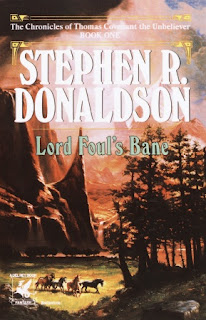
- Getting LORD FOUL'S BANE published proved to be a long and winding road for you. How rewarding is it to see that it's still in print 30 years later?

It's amazing what you can become accustomed to. After my vast difficulties finding a publisher in the first place, simply seeing a physical copy of "Lord Foul's Bane" was a transcendant experience. Now everything that I've ever published is still in print--and I take that for granted. I suspect that this does not speak well of me.

- What do you feel is your strength as a writer/storyteller?

For whatever it's worth, in my opinion my greatest strength is my ability to organize a large narrative canvas. Even when my "epics" appear to sprawl, they contain nothing that doesn't contribute to the effect and meaning of whole. Seen simply as an exercise in story design, my 5-book GAP sequence is a thing of beauty. (Do I need to repeat that this is just my opinion?)
- Characters often take a life of their own. Which of your characters did you find the most unpredictable to write about?

Ribuld and Argus in "Mordant's Need". No characters before or since have taken me by surprise the way they did.

- You have been writing novels for three decades. What has changed the most in the fantasy genre since you began your career?

For two decades before I broke into print, there was "The Lord of the Rings"--and virtually nothing else. Six months before I was first published, Terry Brooks made a splash with "The Sword of Shannara". Now we're up to our hips in fantasy novels and series of every conceivable description--and quality. In general, this seems good to me. But it does make it more difficult--you should pardon the cliche--to separate the wheat from the chaff.

- What advice would you give a younger Stephen R. Donaldson concerning his writing career? Looking back, would you have done anything differently?

No, I would not have done anything differently. But if I could communicate now with my younger self, I would urge that Stephen R. Donaldson to trust himself more.

- Many fantasy authors don't read within the genre. Is it the case with you? If not, what authors make you shake your head in admiration these days?

I'm a very slow reader, but I do read a fair amount of fantasy and science fiction. Writers whom I especially admire include: Patricia A. McKillip, Steven Erikson, and Tim Powers.

- After producing all those bestsellers and selling millions of copies worldwide, after winning literary awards, is there added pressure when it comes to writing new series/novels, knowing that the expectations will always be high?

I do suffer from a kind of "performance anxiety" that I associate with competing with myself. So many people enjoyed the first six "Covenant" books--and I've made them wait so long to complete the story--that I can hardly bear the prospect of disappointing them. In the long run, however, I'm more concerned about doing justice to the story. For that reason, I hope that my own expectations for myself are higher than anyone else's for me.

- The fact that you have an official website on the internet is an indication that interaction with your readers is important to you as an author. How special is it to have the chance to interact directly with your fans?

Actually, my website does *not* indicate that interaction with my readers is important to me. It indicates that my publishers want me to do more to promote my own books. Nevertheless I *do* benefit from interaction with my readers, and I value it. Primarily through conventions, every writer of science fiction and fantasy is blessed with access to his/her audience(s): access which does not exist to the same extent in any other form of literature. As a result, I don't need a website to help me interact with my readers.

That said: the interactions on my website are more focused (therefore more efficient? certainly more concrete) than those that occur at conventions. My website has benefitted me in ways that I didn't expect when I started it.

- Honestly, do you believe that the speculative fiction genre will ever come to be recognized as veritable literature? Truth be told, in my opinion there has never been this many good books/series as we have right now, and yet there is still very little respect (not to say none) associated with the genre.

I think that the recognition of the best work in our field as serious literature is inevitable--although I don't expect that recognition to come quickly enough to do either of us any good. It is a fact that the oldest and most enduring forms of literature in every language of every culture on the planet are fantasy. This simply cannot be an accident: it has to be an important statement about how human beings find meaning. Well, we live in a cynical time: "meaning" is out of favor. But this phase will pass eventually. Time will ensure that any work which deserves the status of Literature will receive its due.

- More and more, authors/editors/publicists/agents are discovering the potential of all the SFF blogs/websites/message boards on the internet. Do you keep an eye on what is being discussed out there, especially if it concerns you? Or is this too much of a distraction?

No, I don't visit blogs/websites/messages boards. Indeed, I spend as little time on the Internet as possible. Sure, those things are distractions--not to mention black holes for time. But that's not the primary reason I avoid it. I avoid it because it's bad for me. Poking around on the web trying to find out what people are saying about me sounds a whole lot like middle school; and I really need to be an adult.

- M. John Harrison recently wrote this post on his blog:

"Every moment of a science fiction story must represent the triumph of writing over worldbuilding.

Worldbuilding is dull. Worldbuilding literalises the urge to invent. Worldbuilding gives an unneccessary permission for acts of writing (indeed, for acts of reading). Worldbuilding numbs the reader’s ability to fulfil their part of the bargain, because it believes that it has to do everything around here if anything is going to get done.

Above all, worldbuilding is not technically neccessary. It is the great clomping foot of nerdism. It is the attempt to exhaustively survey a place that isn’t there. A good writer would never try to do that, even with a place that is there. It isn’t possible, & if it was the results wouldn’t be readable: they would constitute not a book but the biggest library ever built, a hallowed place of dedication & lifelong study. This gives us a clue to the psychological type of the worldbuilder & the worldbuilder’s victim, & makes us very afraid."

Needless to say, a multitude of people disagree with Harrison's postulation. What's your take on Harrison's post and the concept of worldbuilding in general?

It's difficult to argue with Harrison's position as he's expressed it here. (Remember, however, that he has assigned a specific meaning to the term "worldbuilding"--a meaning which the term might not have if someone else used it.) Indeed, I would be inclined to go a little further: "Every moment of any literature must represent the triumph of writing over worldbuilding." Or I might re-state Harrison's position to more accurately reflect my own (without, I hope, doing too much violence to his views): "Every moment of any literature must represent the triumph of storytelling over worldbuilding."

Of course, we could make the whole issue go away simply by assigning a different meaning to "worldbuilding". But where would be the fun in that?

Many thanks again for accepting to do this interview. And thank you as well for all those wonderful novels! We wish you continued success with your writing career and best of luck with the forthcoming release of FATAL REVENANT.